
Saturday, September 10, 2016

Wednesday, March 9, 2016
Route 1 Renaissance: Development Projects in College Park and Beyond
The busy corridor is quickly maturing into a vibrant, urban hub
 |
| #1 Liquor is the lone holdout on this block of US Route 1 in College Park after being surrounded by high-density residential development Photo credit: Google StreetView |
College Park, Maryland is home to the flagship campus of the University of Maryland (UMD), but has frequently been criticized as a middling college town, especially compared to other well-known college towns around the country such as Berkeley, CA and Ann Arbor, MI. Critics have given a number of reasons as to why College Park is considered to be a mediocre college town:
- the lack of quality retail establishments
- a heavily congested main road artery lined with not-so-attractive businesses
- poor access to the existing rail transit station
- a relatively high crime rate.
The major transportation corridor for College Park and its neighbors is US Route 1 (Baltimore Ave./Rhode Island Ave.)--the national highway famous for connecting Maine and Florida. In addition to being the area's busiest vehicular artery, it has also been its primary commercial strip for nearly 100 years. Although there has been a steady stream of new development projects going up around College Park in recent years, many obsolete buildings, and the street itself seem to be stuck in a time warp.
Fortunately, the recently funded reconstruction of US Route 1, which will include widening, the addition of bike lanes, and a much improved environment for pedestrians which will do a lot to alleviate congestion and improve mobility.
Just as important, as far as transportation infrastructure is concerned, is the Purple Line light rail line, which will be built through the heart of the UMD campus to connect the school to the existing College Park Metro/MARC rail station, as well as the commercial hubs of downtown Bethesda and Silver Spring.
Notably, the high-quality projects coming to the Route 1 Corridor are attracting nationally recognized names such as: CVS, Hyatt, Choice Hotel's premium Cambria Suites brand, Whole Foods (opening its first store in the county), and Target (which is opening one of its first urban-format TargetExpress stores in the country).
Continue reading for a list of all the mixed-use development projects recently completed (past 10 years), planned, or under construction in the Route 1 Corridor in College Park and beyond:
*Remember to check my comprehensive Urban Development Map for more details on these development projects and others in the area.
Tuesday, February 10, 2015
Downtown Bethesda's Sector Plan Rewrite
As the urban hub's build out continues planning officials move to increase density to accommodate future growth
As I wrote last February (in what turned out to be the site's most popular post), downtown Bethesda is in the middle of a huge building boom with a number of development projects recently completed or currently under construction. In light of this flurry of development activity, the Montgomery County Planning Commission is in the process of rewriting the downtown area's sector plan (last rewritten in 1994) to accommodate the urban district's tremendous growth now and into the future. Among other things, the new plan seeks to: improve and increase the amount of public space, add a "greenway," increase the number of affordable housing units, improve connectivity (pedestrian, transit, bicycle, and auto), and focus growth in certain areas. Last December, preliminary concepts were presented by planning staff to the planning board for review. Between 2010 and 2040 the Bethesda downtown district was projected to add 14,200 jobs and 5,300 households. To help accommodate this growth, planning staff proposed raising height limits and increasing density in a number of specific areas of the urban district. Below is a map of these new height limits:
 |
| Blue - Symbolic Center and Civic Gathering Spaces Red - Expanded/Emerging Centers of Activity Yellow - Affordable Housing, Park Connectivity and Community Facilities Green - Eastern Greenway |
During the zoning rewrite process (which is scheduled to be completed by the end of the year), different landowners and developers were encouraged by planning staff to discuss plans or submit ideas for their sites, and how they thought the new sector plan should accommodate them.
Updated: Bethesda's Building Boom
The list of development projects in downtown Bethesda has been updated

Monday, January 26, 2015
Violent Crime in the Mid-Atlantic
Decline of Violent Crime/Homicides Continued in 2014
 |
| Metropolitan Police Dept. of the District of Columbia (MPD) Patrol Car, Washington D.C. Photo Credit: Joe Flood via Flickr |
 |
| New York Police Dept. (NYPD) Officer and Patrol Car, New York City Photo Credit: Jay Miller via Flickr |
 |
| NYPD Precinct Times Square, New York City Photo Credit: Tony Fischer via Flickr |
Below is a table listing the frequencies and rates of violent crime and homicide in the Mid-Atlantic's largest cities in 2013 and 2014:
| City | Population | Violent crime |
Rate /100,000 | Murders 2013 | Rate /100,000 | Murders 2014 | Rate /100,000 |
| Baltimore, MD | 622,671 | 8,725 | 1,401.2 | 233 | 37.4 | 211 | 33.9 |
| Newark, NJ | 278,246 | 3,516 | 1,263.6 | 112 | 40.3 | 93 | 33.4 |
| Buffalo, NY | 258,789 | 3,249 | 1,255.5 | 47 | 18.2 | 62 | 24.0 |
| Pittsburgh, PA | 307,632 | 2,259 | 734.3 | 45 | 14.6 | 71 | 23.1 |
| Washington, D.C. | 646,449 | 7,880 | 1,219.0 | 103 | 15.9 | 105 | 16.2 |
| Philadelphia, PA | 1,553,153 | 17,074 | 1,099.3 | 247 | 15.9 | 248 | 16.0 |
| Jersey City, NJ | 256,886 | 1,655 | 644.3 | 20 | 7.8 | 23 | 9.0 |
| New York, NY | 8,396,126 | 52,384 | 623.9 | 335 | 4.0 | 328 | 3.9 |
*The 2013 numbers are from 2013 edition of the FBI's annual Uniform Crime Report published last fall. Homicide totals for 2014 are from local media reports and the rates are based on 2013 population numbers
Wednesday, December 17, 2014
City Halls of the Mid-Atlantic
The region boasts a vast collection of architecturally impressive municipal headquarters
The city hall is the principal administrative building of a city. As symbols of local government, city halls often have distinctive architecture, and many of these buildings have great historical significance, being among the oldest buildings in their cities.
The Mid-Atlantic region, which is one of the oldest and most heavily populated regions in the nation, is home to a relatively large number of city halls. As you'll see further down this page, certain city halls in the Mid-Atlantic hold records for being largest, tallest, or oldest in the nation.
Most city halls in the region were built in the late 1800's when urban areas began to see heavy population growth, and municipal government services were in high demand. City halls in this era were usually built in central locations and designed in some form of Revival Architecture which gave these buildings with a grand presence. In addition to their elaborate architectural, many city halls were the among the largest buildings in their respective cities, and some still are today.
Below you can view photos and information of the most exquisite city halls located in the Mid-Atlantic's largest (incorporated) cities.
WASHINGTON D.C.
 |
| John A. Wilson Building Photo Credit: Wally Gobetz via flickr |
Architectural Style: Beaux Arts
City Population (2013): 646,449
Notes: Originally named the "District Building," the John A. Wilson Building is the city's second city hall. The original city hall was constructed in 1820 in the Neoclassical Style and is currently home to the District of Columbia Court of Appeals
DELAWARE
Wilmington
 |
| Daniel L. Hermann Courthouse |
Architectural Style: Neoclassical Revival-Greek Revival
City Population (2013): 71,525
Notes: This building originally held a number of courts and municipal offices and was at one point informally named the "Public Building," receiving it's current name only a couple of decades ago. The city and county government offices eventually moved to the Louis L. Redding City-County Building (built 1977) and in 2002 the courts moved to the newly built Justice Center, leaving the building vacant. The building was eventually purchased by developers and converted to office space, which has been occupied by a prestigious law firm since 2009.
MARYLAND
Baltimore
 |
| Baltimore City Hall |
City Population (2013): 622,104
Notes: Designed by George Aloysius Frederick, a 22-year old architect. The building cost $2,271,136 and took eight years to complete.
Annapolis
 |
| Annapolis City Hall |
Architectural Style: Neoclassical-Georgian
City Population (2013): 38,722
Notes: The original structure on this site was known as the "Ball Room" and used as different points in history as a meeting place of the Maryland Assembly, local headquarters
of Union troops during the Civil War, a guard house, and a prison camp. While being used as a prison camp it burned down and a new city hall was built on the ruins using three of the exterior walls of the original building.
Monday, November 10, 2014
Downtown Silver Spring's Upcoming Wave of Development
Development boom poised to be biggest since the 1960's
|
| Skyline of Downtown Silver Spring in 2012 Photo Credit: Dan Reed via flickr |
With the completion of Fenwick Station this past July and the upcoming delivery of the Residences at Thayer this fall, the current wave of building construction in downtown Silver Spring is now tapering to an end (the publicly-funded library and transit center projects are exceptions). The lull in development will be short-lived however, as downtown Silver Spring is on the verge of seeing yet another development boom in the coming years. This next wave of construction is poised to be even bigger than the last wave, which was already the urban hub's largest in nearly half a century.
A History of Development in Downtown Silver Spring
Silver Spring was originally 'founded' in 1840 when Francis Preston Blair and his daughter discovered a spring flowing with chips of mica on land just north of the Washington D.C. border. Blair later purchased the land surrounding the spring to create a summer estate which he named "Silver Spring."
By the early 1900's Silver Spring had begun to grow into a small suburban town on the B&O Railroad's Metropolitan Branch. During the 1960's, the growing commercial hub experienced it's first high-rise construction boom, along with other lower county communities. Between 1961 and 1971 an impressive 23 high-rise buildings were constructed in downtown Silver Spring. However, following the boom was a long dearth of building activity, and the downtown area entered into a period of economic decline from the mid-1970's onward. Even the arrival of Metro's Red Line in Downtown in 1978 did little to rejuvenate the area.
Downtown Silver Spring didn't really see any significant construction activity again until the arrival of the National Oceanographic and Atmospheric Administration (NOAA) headquarters in the late 1980's and early 1990's. NOAA's massive complex along East-West Highway added four high-rise office buildings to the urban center's skyline, including two of its tallest buildings. Despite the economic boost brought by the NOAA headquarters, the development lull in downtown Silver Spring continued throughout the 1990's.
 |
| The center of Downtown Silver Spring |
At the beginning of the 21st century, signs of new life began to emerge in downtown Silver Spring. Several city blocks near the decades-old City Place Mall were completely demolished to accommodate a new 440,000 sq. ft. outdoor retail/entertainment center. In 2003, Discovery Communications completed construction of its new headquarters in the center of the business district, a move the really accelerated Silver Spring's resurgence. Between 2001 and 2010, nearly 15 new high-rise buildings were constructed in Silver Spring compared to the 6 built during the previous decade .
In addition to the surge of private investment, heavy public investment from Montgomery County, as well as the nationwide 'back to the city' movement, also played major roles in Silver Spring's rejuvenation. However, with the still depressed office market, nearly all of the new development in downtown Silver Spring has been residential (with retail components). Between May 2013 and July 2014 an unprecedented six residential apartment buildings (the same total number of buildings completed over the entire decade of the 1990's!) were completed in Silver Spring.
The Next Wave
As huge as the recent development blitz has been, the upcoming wave could likely surpass it, and possibly the massive 1960's boom. There are over 20 planned or approved high-density projects currently in the pipeline for downtown Silver Spring, with 12 buildings projected to be completed by 2018.
Below you can find detailed information on every development project currently in the works for downtown Silver Spring:
*Remember to check my comprehensive Urban Development Map for more details on these development projects as well as every project completed since 2005 in Downtown Silver Spring.
Wednesday, September 24, 2014
Where We're From
Where people living in the Mid-Atlantic were born
The Mid-Atlantic is one of the most diverse geographic regions of the nation, with residents of many different backgrounds, races, and cultures. While a small majority of the region's residents are native to the region, a large proportion of residents are transplants from other regions of the country or immigrated here from other countries. Last month, the New York Time's The Upshot blog published interactive graphs detailing where the residents of all 50 states and D.C. originated from (and migrated to) using recent US Census data. (NOTE: Click "Switch to Migration" button above graph to see origination data).
Using the data from the graphs and the Census site, I decided to focus specifically on the Mid-Atlantic states and created my own graphs (above). As you can see, approximately 62% of people living in the Mid-Atlantic are native to their current state of residence, while approx. 20% where born in another state (including another Mid-Atlantic state), and a significant 18% were born overseas. Although, these numbers only focus on one aspect of diversity, place of origin, they really underscore the fact that the Mid-Atlantic is a very cosmopolitan region. Glancing at the detailed tables on the NY Times page also reveals that this diversity has been steadily increasing over time, and it won't be surprising if Mid-Atlantic residents native to their home state are in the minority at some point in the next few decades.
Of course, there's a large demographic variation between the Mid-Atlantic states. For instance, in Pennsylvania, a whopping 74% of the population was born in that state, while only 37% of Washington D.C. residents were born in the District. As for immigrants from overseas, a very sizable 25% of New York state residents were born in another country, while a paltry 2% of West Virginia residents were born outside of the U.S.
Tuesday, September 16, 2014
The Best Colleges and Universities in the Mid-Atlantic
How the region's higher education institutions stack up against the rest of the country and each other
 |
| Nassau Hall on the campus of Princeton University (Princeton, NJ) - the #1 ranked university in the country Photo Credit: Flickr user schizoform |
2015 'National University' Rankings (Mid-Atlantic schools in bold)
| Rank | School Name | Location |
| 1. | Princeton University | Princeton, NJ |
| 2. | Harvard University | Cambridge, MA |
| 3. | Yale University | New Haven, CT |
| 4. (tie) | Columbia University | New York, NY |
| 4. (tie) | Stanford University | Stanford, CA |
| 4. (tie) | University of Chicago | Chicago, IL |
| 7. | Massachusetts Insitute of Technology | Cambridge, MA |
| 8. (tie) | Duke University | Durham, NC |
| 8. (tie) | University of Pennsylvania | Philadelphia, PA |
| 10. | California Institute of Technology | Pasadena, CA |
| 11. | Dartmouth College | Hanover, NH |
| 12. | Johns Hopkins University | Baltimore, MD |
| 13. | Northwestern University | Evanston, IL |
| 14. | Washington University in St. Louis | St. Louis, MO |
| 15. | Cornell University | Ithaca, NY |
| 16. (tie) | Brown University | Providence, RI |
| 16. (tie) | University of Notre Dame | Notre Dame, IN |
| 16. (tie) | Vanderbilt University | Nashville, TN |
| 19. | Rice University | Houston, TX |
| 20. | University of California—Berkeley | Berkeley, CA |
| 21. (tie) | Emory University | Atlanta, GA |
| 21. (tie) | Georgetown University | Washington, D.C. |
| 23. (tie) | University of California—Los Angeles | Los Angeles, CA |
| 23. (tie) | University of Virginia | Charlottesville, VA |
| 25. (tie) | Carnegie Mellon University | Pittsburgh, PA |
| 25. (tie) | University of Southern California | Los Angeles, CA |
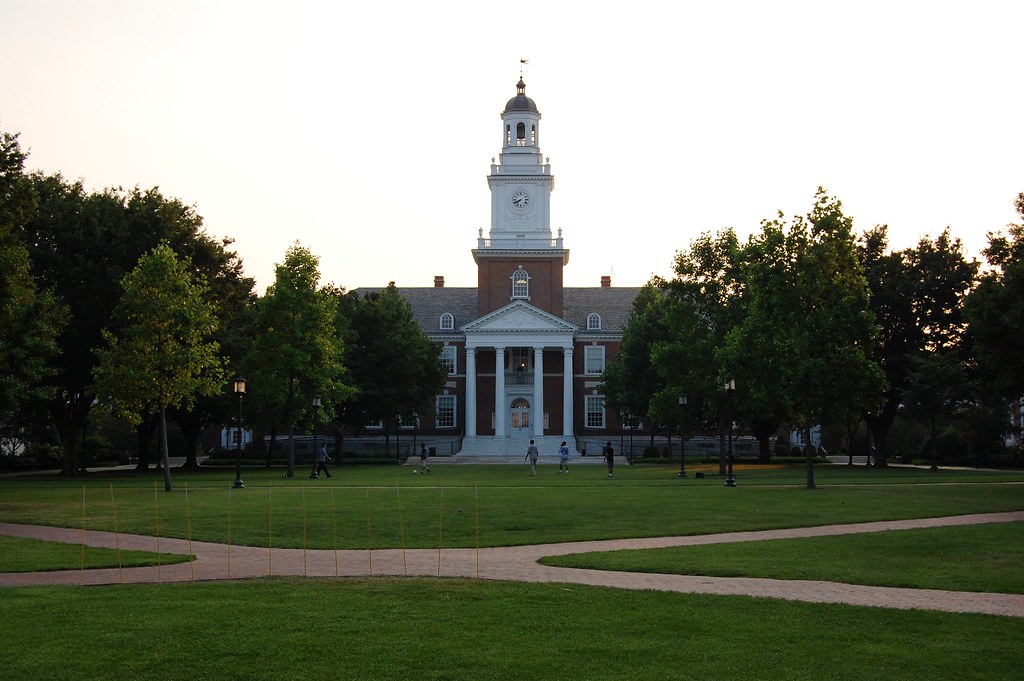 |
| Gilman Hall, Johns Hopkins University (Baltimore, MD) - 12th ranked national university Photo Credit: Flickr user clio1789 |
The seven Mid-Atlantic schools in the top 25 'National Liberal Arts Colleges:'
| Rank | School Name | Location |
| 3. | Swarthmore College | Swarthmore, PA |
| 8. (tie) | Haverford College | Haverford, PA |
| 11. | Vassar College | Poughkeepsie, NY |
| 13. | United States Naval Academy | Annapolis, MD |
| 15. (tie) | Hamilton College | Clinton, NY |
| 22. | Colgate University | Hamilton, NY |
| 24. | United States Military Academy | West Point, NY |
Wednesday, September 10, 2014
The Mid-Atlantic's Most Expensive Urban Condos
These extremely pricey, ultra-luxury, ultra-extravagant, ultra-exclusive properties cater to celebrities, CEO's, and power brokers
This past spring a 6,737 sq. ft. condominium unit in Friendship Heights, MD sold for $8.65 million to an undisclosed buyer, a new record for the Washington D.C. area. This happened barely a year after the same unit set the previous sale record at $7.95 million. The 18th-floor penthouse unit located at the exclusive Parc Somerset high-rise has five bedrooms, five bathrooms, 300-degree views, multiple balconies, and a solarium.
In light of this record-breaking sale and the resurgence of the urban luxury condo market, this is a great time to look at the most expensive condominium units in the major urban areas of the Mid-Atlantic. As you'll see below, New York is clearly the champion (by a mile) of commanding stratospheric prices for condo units.
Washington D.C. Area
Parc Somerset
 |
| Parc Somerset |
Building height: 18 stories
Location: Friendship Heights, MD
Located just a half mile across the border from Washington D.C. in the urban Friendship Heights neighborhood of Chevy Chase, MD, Parc Somerset is part of a three building condo complex collectively called Somerset House which is composed of high-rises 18 to 21 stories tall. Despite being nestled in a gated 17-acre park-like oasis that includes tennis and racquetball courts, clubhouse, and gym, residents are within walking distance of plenty of shopping and transportation amenities. These include ultra-high end stores such as Saks 5th Avenue, Cartier, Bulgari, Ralph Lauren, Jimmy Choo, Bloomingdale's, Neiman Marcus, and Tiffany's which line a segment of Wisconsin Ave known as the "Rodeo Drive of DC," a plethora of upscale restaurants, Whole Foods and Giant grocery stores, and a Metro station on the Red Line. Residents include former National Football League Commissioner Paul Tagliabue and JLL CEO Colin Dyer.
Upcoming competition:
The Lauren Bethesda
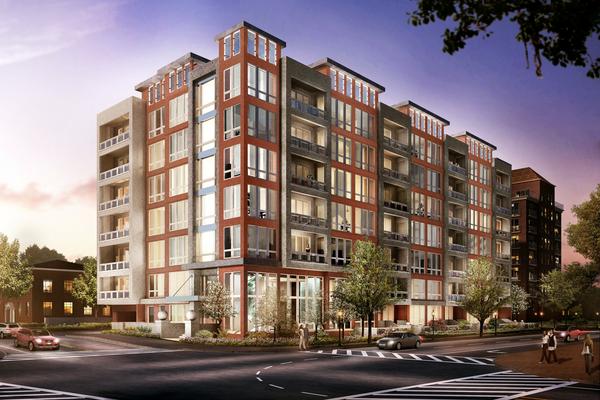 |
| The Lauren Bethesda |
In addition to The Lauren, luxury home-builder Toll Brothers is preparing to construct their own 7-story condo building practically next door on the same block. There are three other condo projects on the near term horizon in Downtown Bethesda, the current hotspot for luxury condos in the Washington D.C. Area.
Philadelphia Metro Area
1706 Rittenhouse Square Street
 |
| 1706 Rittenhouse |
Building height: 31 stories
Location: Center City, Philadelphia, PA
Located in one of the most desirable neighborhoods in Philadelphia, this 31-story luxury high-rise was completed in 2010 and is currently 100% sold. The building is currently home to surgeons, pediatricians, real estate magnates, CEOs, and two Phillies pitchers. Each 4,200 sq. ft. unit is comprised of a full floor (with the exception of the two-story penthouse) and has a floor-plan customized by the buyer. One special amenity of note is an automated, 64-space underground parking garage. Residents use their fob to call for their vehicle from the garage or from within one of the two elevator banks.
Upcoming competition:
500 Walnut
 |
| 500 Walnut |
Monday, August 18, 2014
Atlantic City's Ongoing Gambling Woes Get Worse
The Collapse of the City's Casino Market Continues as the Revel Becomes the Fourth to Close this Year
 |
| Revel Casino, Atlantic City, NJ |
The most recent closing announcement is almost certainly the most tragic, but not all that surprising. Yesterday, the owner of Revel announced that the casino would close no later than Sept. 10 of this year. The fact that the casino (which was in its 2nd bankruptcy at the time of my June post) has only been open for hardly two years and cost around $2.4 billion to construct just makes its closure all the more shocking. It's hard to imagine a more colossal waste of investment.
In addition to the Revel, Showboat Casino (opened 1987) and Trump Plaza (opened 1984) will also be closing within a month. The Atlantic Club (opened 1980) was shuttered in January. Currently, these are the only closings planned, but it wouldn't be surprising if they aren't the last. Of course, it's extremely unlikely that all of the city's casinos will close, but to cope with the increasing demand the market will need to "right size" by lowering gaming/hotel room supply to match the lower demand at a new equilibrium. There's no telling how long that will take, especially since there are still casinos in Maryland and Pennsylvania, (and now New York) that have yet to open.
Friday, July 25, 2014
The "Snobbiest" Small Cities in the Mid-Atlantic
 |
| Bethesda Row in Bethesda, MD - #2 Snobbiest Small CIty Photo Credit: ehplen via Flickr |
While I'm not sure I agree with the use of the word "snobby" to describe these admittedly affluent cities, since it could be viewed as derisive to their residents (personally I would use "preppy"), the ranking does seem to be somewhat accurate. (I tend to appreciate rankings that actually use statistical data as criteria, rather than anecdotal experiences or informal polls.) Out of the top 10, three of the cities are located in the Mid-Atlantic: Bethesda, MD (#2), Hoboken, NJ (#6), and Rockville, MD (#8).
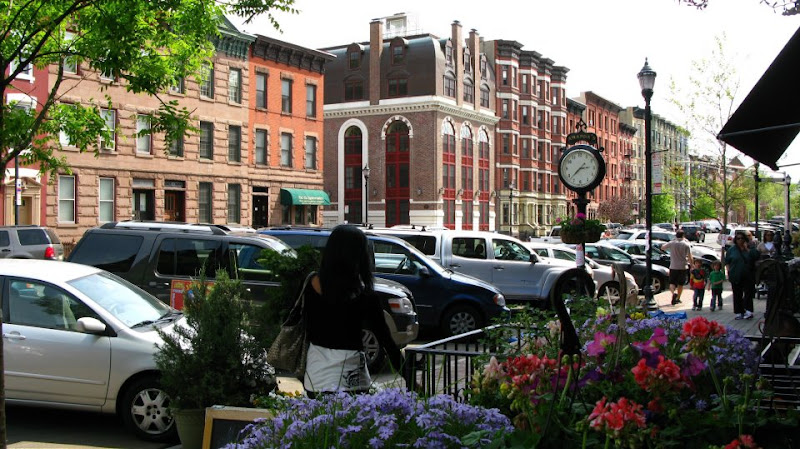 |
| Washington St in Hoboken, NJ - #6 Snobbiest Small City Photo Credit: City of Hoboken |
The other issue with this ranking is that it doesn't take into account relative wealth. For instance, in Montgomery County, Rockville isn't really viewed as a "snobbish" or particularly exclusive city, especially compared to it's neighbors immediately to its south. Compared to other cities in other states it might seem very well-to-do, but in the 2nd wealthiest metro area, in the 2nd wealthiest county of the wealthiest state in the nation it is merely "upper middle-class."
| Top 10 "Snobbiest" Small Cities in America | ||||
| Rank | City | |||
| 1. | Palo Alto, CA | |||
| 2. | Bethesda, MD | |||
| 3. | Brookline, MA | |||
| 4. | San Rafael, CA | |||
| 5. | Walnut Creek, CA | |||
| 6. | Hoboken, NJ | |||
| 7. | Oak Park, IL | |||
| 8. | Encitas, CA (tie) | |||
| 8. | Rockville, MD (tie) | |||
| 10. | Laguna Niguel, CA | |||
Subscribe to:
Posts (Atom)