Showing posts with label Anne Arundel County. Show all posts

Monday, June 30, 2014

The Mid-Atlantic's Casinos

The Gold Rush to Build New Casinos in the Region Continues to Gain Momentum 

Future MGM National Harbor
National Harbor, MD
Photo Credit: MGM
Until about 20 years ago, the only casino gambling options available to residents of the Mid-Atlantic were located in Atlantic City, New Jersey. Today, while other regions still only have legalized casino gambling concentrated in select few jurisdictions (particularly in the South and West), every state in the Mid-Atlantic region has legalized at least some form of (strictly) regulated commercial gambling and has at minimum solicited bids for the construction of multiple casinos.

Casinos in the Mid-Atlantic: The Numbers
Number of:DelawareMarylandNew JerseyNew YorkPennsylvaniaWest Virginia
Casinos36*11913*5
   - Commercial030040
   - Racinos310964
   - Resort0211031
Slot Machines/VLTs7,00012,89324,36815,77927,2508,020
Table Games1724021,5400785228
Hotel Rooms50050017,6385731,3781,520


*Includes one casino to be constructed in the near future


Resorts International Atlantic City: the East Coast's first casino
Atlantic City, NJ
History of Mid-Atlantic Casinos
Casino gambling first arrived in the Mid-Atlantic in 1978 in Atlantic City. ("Gambling halls" with slot machines did exist previously however in Charles County, MD from 1949 until they were outlawed in 1968). Between the end of World War II and the 1970's, the previously well-regarded resort city had entered into a steep decline, becoming plagued crime, poverty, and corruption. In an effort to revitalize the city, in 1976 New Jersey voters approved casino gambling for Atlantic City. Immediately after the legislation passed, the owners of the Chalfonte-Haddon Hall Hotel began converting it into the Resorts International. It was the first legal casino in the eastern United States when it opened on May 26, 1978 and still exists among 10 other casinos currently operating in the city.

While Atlantic City never reached the success of Las Vegas--the so-called "Entertainment Capital of the World"-- the city's casinos helped the city regain its status as a desirable resort destination, one of the most popular in the nation by the end of the 1980's. 
The success didn't last long though. WIth the advent of two Native American casinos in Connecticut and the era of "mega resorts" in Las Vegas in the 1990's, tourism in Atlantic City began a period of decline that continues to this day. The arrival of casino gambling in neighboring states has significantly compounded the problem and will likely continue to do so into the future.


Aerial view of Hollywood Casino at Charles Town Races
Charles Town, WV
Casino Gambling Expands Beyond Atlantic City
Atlantic City's first wave of regional competition appeared in 1994 when both Delaware and West Virginia legalized gambling at "racinos"--combined horse (and dog) racetracks and casinos. Two years earlier, in New England, Rhode Island had also legalized racinos. Racinos proved to be very successful, particularly in West Virginia, and helped revitalize run-down racetracks as well as provide an overall boost to the horseracing industry. Legalization of racinos soon spread across the country, as far away as New Mexico, and are now legal in a total 12 states. New York, one of the most recent states to authorize racinos, legalized them in October 2001, and there are now 9 located throughout the state, including two located in or near New York City: Empire City Casino at Yonkers Raceway and Resorts World Casino New York at Aqueduct Racetrack. The opening of the New York  casinos further added to the misfortunes of the Atlantic City casinos.


SugarHouse Casino
Philadelphia, PA
Later in the decade, the legislatures of Maryland and Pennsylvania (the last two commercial gambling holdouts in the Mid-Atlantic) both passed measures to legalize casino gambling in 2008 and 2004 respectively. Unlike the other states of the region (except New Jersey), both states went a step further than racinos by legalizing a limited number of stand-alone casinos with strict restrictions attached. In addition to seven racino licenses, Pennsylvania made five licenses available stand-alone casinos (two in Philadelphia, one in Pittsburgh, and two at-large), and additional two to existing hotel resorts. Maryland passed similar legislation (ratified by voters in a 2008 referendum) which allowed the construction of five casinos in four counties and Baltimore city geographically dispersed throughout the state. Two of these casinos were built as racinos at existing horse tracks.


Horseshoe Casino Baltimore (opening fall 2014)
Baltimore, MD
Custom Google Map with location, pictures, and critical info of every casino in the Mid-Atlantic:

(Tip: Press the box above the map in the top right corner for a better view)

Monday, November 4, 2013

Soaring to New Heights: The Growing Airports of the Mid-Atlantic

John F. Kennedy (JFK) International Airport in New York, NY
Image courtesy allairports.net
According to the FAA's report on the busiest airports in the US (by total passenger boardings) for 2012, eight of the 50 busiest airports in the nation are located in the Mid-Atlantic. Of these eight airports, three are in the New York metropolitan area, three are in the Baltimore-Washington metro area, one is in the Philadelphia metro area, and one is in the Pittsburgh metro area. The busiest American airport in 2012 was once again Atlanta's Hartsfield-Jackson International Airport with 45,798,809 enplanements. The busiest airport in the Mid-Atlantic (and 6th busiest nationally) was New York's John F. Kennedy International Airport.

Spotlight on BWI Airport: Rapidly expanding airport regains title of busiest airport in Balt-Wash Metro


In recent years Baltimore-Washington Thurgood Marshall Airport (BWI Airport), has been experiencing a renaissance of sorts. Built in 1947 in unincorporated Anne Arundel County, MD near Glen Burnie, and originally named Friendship International Airport, it became the first airport in the region (and one of the first in the nation) with the ability to serve jet aircraft in 1957. In 1974, Friendship Airport (which is approximately equidistant from Washington D.C. as Dulles Airport) was renamed Baltimore/Washington International Airport to attract a greater share of the Washington D.C. air travel market. BWI Rail Station, which was dedicated on October 23, 1980, further increased the airport's connection to the Washington D.C. market and was the first intercity rail station in the U.S. built to service an airport.

Promotional shot of Friendship airport on opening day in 1947
Image courtesy of Kilduffs
In the following decades BWI grew to become a major domestic and international airport, as well as an important hub for Piedmont Airlines (and later it's successor USAir/US Airways) all the while maintaining its status as busiest airport in the region. BWI's legacy as a hub for low-fare airlines began in 1993 when Southwest Airlines selected BWI Airport as their East Coast gateway and has steadily expanded ever since. In 1997 the airport completed several major expansion projects including a parking garage expansion providing a total of 5,600 spaces and a $140 million international terminal which included a MTA Light Rail station serving a branch extension of the system. Four years later AirTran Airways launched service to Atlanta and Boston and proceeded to grow a hub that eventually saw 5,100 passengers a day to 29 non-stop destinations in 2011, when the airline merged with Southwest. In the same year BWI was named the fastest-growing of the 30 busiest airports in the nation.

Tuesday, August 6, 2013

Urbanizing America: The Mid-Atlantic

The Baltimore-Washington Metro Area from Space
(Washington D.C. at top of photo, Baltimore is below) 
Image Courtesy of NASA Johnson Space Center
White Flight and Suburbanization
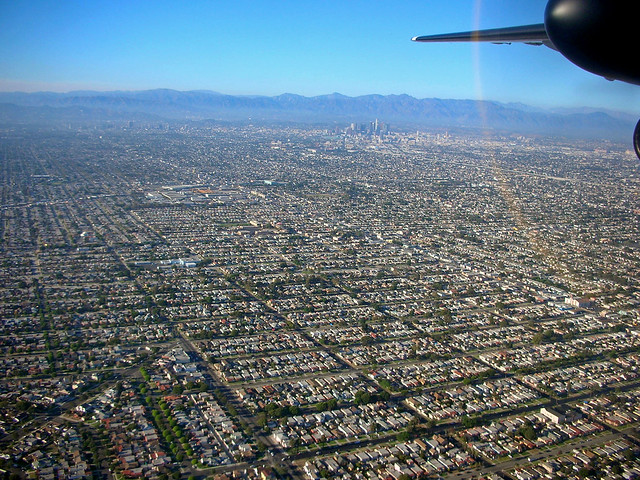
Suburban sprawl around Los Angeles
Image by flickr user ATIS547
While most metropolitan areas in the Mid-Atlantic continue to grow steadily, population growth within the metro areas themselves, in terms of cities vs suburbs, is uneven. From the 1950's up until the early 2000's population and economic growth in America has been strongest in its suburbs. There were a large number of catalysts for this growth shift out of urban areas, the most notable of which is the "white flight" phenomenon of white Americans leaving industrial cities for new housing in their suburbs. This in turn was precipitated by the “Great Migration” of economically disadvantaged African-Americans from the South (were racism was still prevalent and job opportunities scarce) to industrialized cities in the Northeast and Midwest between 1940 and 1970. As blacks moved into traditional white European-American neighborhoods, ethnic frictions served to accelerate flight into the suburbs because of lower property values and higher crime rates.