Tuesday, May 27, 2014

Baltimore's Skyscrapers (Part II)

New Skyscrapers to Elevate City Skyline

414 Light St
Two weeks ago, I wrote about recent skyscraper proposals in Baltimore that didn't survive the recession. Now that Baltimore is well on its way to recovery, and development demand in the city is again on the rise, there have been quite a few new high-rise proposals put forth by developers. Not surprisingly, the vast majority of these proposals are primarily residential in nature, particularly rental apartments, but there is at least one build-to-suit office project as well as a condominium project on the near-term horizon. 

According to 2014 release of the Downtown Partnership of Baltimore\s annual development report, there are 1,137 apartment units under construction and over 2,010 units in the planning (including office-to-residential conversions). The report also estimates that over the course of the next several years, an additional 3,300 housing units, 550 hotel rooms, 300,000 sq. ft. of retail space, 560,000 sq. ft. of office space, and 760,000 sq. ft. of institutional space will be added to the Downtown Baltimore market.

Despite the promising statistics, the Baltimore real estate market is still struggling in a number of areas. Not only is the office market continuing to be pretty weak (the tallest buildings in nearly all large American city are office buildings), the retail sector has also seen surprisingly sluggish growth (which will likely improve over the long run). In addition, the 'new generation' of Baltimore high-rises are modest in scale compared to the pre-recession proposals. Only one building proposed exceeds 400 ft in height (and even that was greatly reduced from 715 ft.). Developers (and their financial investors/partnersare clearly more cautious and risk-averse now, so this sudden "fear of heights" might unfortunately be a part of a new, post-'Great Recession' reality. 

Another cause for the smaller scale of new skyscrapers, specifically in the residential sector, is the stiff competition  from the ever increasing number of office-to-residential building conversions in the downtown area (thanks to the weak office demand). Some buildings, such as the Four Seasons hotel/condo skyscraper and Exelon headquarters tower, have seen their height reduced significantly

In any case, any additional skyscrapers will be an improvement on the Baltimore skyline which is becoming increasingly aged due to the lack of development. Listed below are the current proposals:

(Note: This list contains buildings proposed to be 200 ft or taller likely to be constructed over the next few years. For existing proposals that have been delayed indefinitely see Part I)

Tuesday, May 13, 2014

Baltimore's Skyscrapers (Part I)

'Charm City's' Tallest Buildings, and Ambitious Proposals Thwarted by the Recession

Proposed 44-story Four Seasons Hotel & Residences
(currently only partially completed)
Last February, I posted an article on the tallest existing and proposed buildings in Washington D.C. and its immediate suburbs. This two-part post will take a look at the tallest buildings in Baltimore as well as the latest proposals for new skyscrapers in the city, (plus some that were proposed over the past decade but never built).

Washington is well known for it's short, uniform skyline with nearly every building being built less than 200 ft. high. Of course this allows the 555 ft. Washington Monument and the 289 ft. U.S. Capitol to easily stand out against the backdrop of mostly 10- to 15-story "highrises." Unlike Washington D.C. though, it's more blue collar neighbor to the north has a more "conventional" urban skyline. Baltimore has a number of considerable number of skyscrapers (defined as buildings over 300 ft on this site) including the tallest building in the entire Baltimore-Washington Region--the 529 ft. Transamerica Tower (formerly the Legg Mason building).

Despite having a significant amount of buildings over 300 ft., Baltimore still lacks any "supertalls" (buildings over 1,000 ft. tall) and it's tallest building is shorter than the tallest buildings of many less-populated cities. A major reason for this has been the weak residential and office market in Baltimore over the last few decades. While Washington D.C. has seen a boom in new residents and hasn't lacked for well-paying jobs thanks to the federal government, Baltimore, on the other hand, has been somewhat struggling to attract and retain businesses as well as residents (as has been the case in many blue-collar cities in the Northeast and Midwest). 

Baltimore's fortunes have begun to change though. A recent reversal of the decades-long population decline and a large influx of residents into the city's core neighborhoods surrounding the Inner Harbor, are promising signs of a brighter future, although business growth has still remained slow. Developers have taken notice of the city's recent resurgence and have proposed (and constructed) a multitude of new buildings in the city (nearly all residential), including skyscrapers. 

Unfortunately, the recent recession took it's toll on Baltimore's real estate market, and many of the more ambitious (read: very expensive to finance) projects have failed or been postponed indefinitely, including a number of buildings that would have been the city's tallest. Below is a ranking of the tallest buildings in the city currently and, following that, proposals for new skyscrapers that were derailed by the recent recession. In a second part to this post will be a list of new skyscraper proposals that are somewhat toned down in scale, but (hopefully) more likely to actually be constructed. 


Transamerica Tower- Currently the tallest building in Baltimore
Below is a ranking of the tallest buildings in Baltimore:

Name Stories Height (ft)
1. Transamerica Tower 40 529
2. 10 Light St 37 509
3. William Donald Schaefer Building 37 493
4. Commerce Place 31 454
5. 100 E Pratt St 28 418
6. Baltimore World Trade Center 32 405
7. Tremont Plaza Hotel 37 395
8. Charles Tower South Apartments 30 385
9. = Blaustein Building 30 360
9. = 250 W Pratt St 24 360


Continue reading to see Baltimore skyscraper proposals that failed during the recent recession:

Wednesday, February 12, 2014

Amtrak's New Northeast Corridor Workhorse

Siemens ACS-64 #600 at Sacramento Manufacturing Facility May 2013
Photo Credit: Siemens/Amtrak (for all images unless otherwise specified)
Last week Friday (Feb. 7) Amtrak's newest fleet member completed its inaugural run on the the busy Northeast Corridor line on Northeast Regional #171 from Boston South Station to Union StationWashington D.C. The brand new Siemens ACS-64 (ACS stands for "American Cities Sprinter") electric locomotive at the head end of the train is the first of 70 of the type to be delivered to Amtrak over a period of roughly two years. The locomotives, which are assembled by Siemens in Sacramento, CA to satisfy the "Buy America" requirement for federal funding, will be delivered at a rate of approximately three per month, with the final units arriving sometime next year. 


ACS-64 engineer's compartment
In addition to eventually powering all Northeast Regional and long-distance trains on the Northeast Corridor (NEC) (which serves Washington D.C., Baltimore, Philadelphia, New York, Boston, and points in between), the new locomotives will also operate on the Keystone Corridor branch line between Philadelphia and Harrisburg, PA. 

The incoming locomotive units will replace the 20 EMD AEM-7 (DC), 29 EMD AEM-7 (AC), and 15 Bombardier/Alstom HHP-8 electric locomotives currently powering trains on the NEC, most having over 3.5 million miles on them. The Swedish-designed AEM-7 locomotives (nicknamed "toasters" and originally all DC units) were delivered to Amtrak between 1978 and 1988. Between 1999 and 2002, 29 of these locomotives were upgraded by Amtrak and Alstom  to "AC" units with greater amount of horsepower allowing them to haul longer trains. 

Wednesday, February 5, 2014

The Mid-Atlantic's Most "Exciting" Suburbs

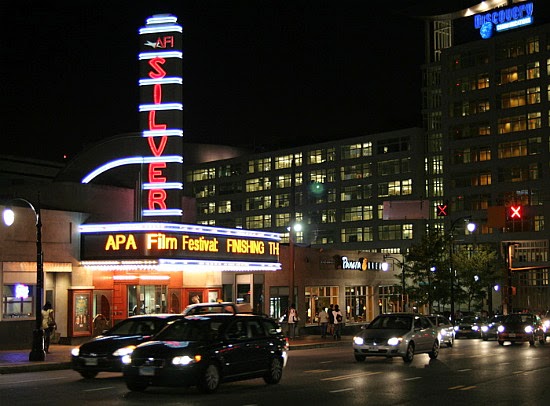
Downtown Silver Spring, MD at night
Photo Credit: UrbanTurf DC
Yesterday, real estate website Movoto released its ranking of the "Most Exciting Suburbs In America." Movoto created its ranking by selecting the 139 largest suburbs (using Census data)
and averaging their ranking over the following 6 criteria:
  • Nightlife per capita (bars, clubs, comedy, etc.)
  • Live music venues per capita
  • Active life options per capita (parks, outdoor activities, etc.)
  • Fast Food restaurants per capita (the fewer the better)
  • Percentage of restaurants that are fast food (the lower the better)
A number of suburbs in the Mid-Atlantic made the top 50 ranking, although none of them made the top 10. The region also seems to be a little underrepresented on the top 50 as well with only with only five suburbs ranked (16% of US population should equal exactly 8 on the list)

The #1 ranked suburb in the nation, Cambridge, MA, isn't really a surprise, neither are a few of the others in the top 10 such as Berkeley, CA and Santa Monica, CA. Some of the other top 10 suburbs however, might cause a few raised eyebrows.  It should come as no surprise though that many suburbs on the list are college towns including the Mid-Atlantic's "most exciting": Towson, MD.

Continue reading to see the national top 10 "most exciting" suburbs ranking as well as the most exciting suburbs here in the Mid-Atlantic.


Tuesday, February 4, 2014

Bethesda's Building Boom: A detailed list of development activity in downtown Bethesda

Photo credit: BethesdaNow.com 
UPDATED 02/06/15

Since the delivery of a few projects between 2008-2009 (in the midst of the recent recession) there had been no new residential or commercial development projects completed in downtown Bethesda, Maryland. That changed just two weeks ago with the opening of the 17-story Gallery Bethesda apartment building in the Woodmont Triangle district. The Gallery is just the first in a slew of new high-density development projects to be constructed over the next few years in downtown Bethesda.

The vast majority of these projects  are residential in nature, with over 3,000 new apartment and condo units in the pipeline. However, a hotel is also in the works, and even a few office buildings, one of which is already under construction--a rarity in Montgomery County these days and Bethesda's first in over a decade. Nearly all of the projects in the pipeline are within walking distance of the Bethesda Metro station and/or the future Purple Line light rail station promoting transit usage.

THE FACTS
Coming to downtown Bethesda over the next several years:
- 30 projects
...including...
- 16 residential mid/high-rise apartment buildings
- 6 residential mid/high-rise condo buildings
- 5 office buildings 
- 2 hotels
- 1 police station
...containing...
- 4,003 residential units 
- 1,022,000 sq. ft. of office space
- 244,680 sq. ft. of retail space
- 452 hotel rooms

Here's a detailed list of all of the medium/high-density development projects going up around downtown Bethesda along with their current statuses (Remember to click on the photos to enlarge):

Tuesday, December 31, 2013

A Review of 2013 and a Look Ahead to 2014

There was quite a number of big news stories coming from the urban areas of the Mid-Atlantic in 2013. Below, we'll take a look at the most notable ones in each major city, as well as some more general trends apparent across the entire region. We'll also look at some of the most highly anticipated events of 2014.

Washington D.C.
Rendering of future DC United Stadium
Photo Credit: DC United
2013
DC United Stadium: DC United reached a tentative deal with the city to construct a new $300 million, 20,000 seat stadium in SW DC. The move is expected to spark continue the "revitalization" of the long-neglected neighborhoods in the area.

New Walmart Stores: The national retail behemoth opened two "urban-style" stores in NW Washington DC this month after a summer of controversy involving a new minimum wage bill that threatened to terminate the projects altogether. Three more stores are planned for the city, including one that is already under construction.

Bridges Complete: The 11th Street Bridges carrying I-695 and MLK Jr. Ave SE across the Anacostia River and the Wilson Bridge carrying the Beltway (I-95/I-495) across the Potomac River were officially completed this year. The bridges were largely complete at the beginning of the year, but minor construction work remained to be finished.

New Transportation Funding: Both Maryland and Northern Virginia received a major boost in funding for new transportation projects and system maintenance thanks to increases in gas and sales taxes respectively. 

City Center DC: The nearly $950 million, 5- block development began to deliver this month with apartments becoming available for lease. The second phase of the development, one of the largest in the nation, is expected to break ground next year and include a luxury hotel.

2013 Spotlight on Prince George's County: Maryland county secures promising future

Rendering of initial vision for MD Housing Dept headquarters
New Carrollton, MD
Photo courtesy: WTOP
Despite it's large population and numerous important institutions (NASA-Goddard, IRS, Census Bureau, Joint Base Andrews, University of Maryland, etc.), Prince George's County, which shares nearly its entire western border with DC, has been struggling to keep pace with other Beltway counties in attracting high-paying jobs and high-quality retail/residential/commercial development. This is probably mostly due to the persistent negative image the county has had because of its relatively high crime rates (despite serious crime being concentrated mainly in small pockets inside the Beltway and decreasing year over year) and schools that are perceived to be of lower quality than those in other suburban jurisdictions. 

That said, 2013 brought some very welcome news for the county in terms of its economic prospects, and the year was no doubt an unqualified success for County Executive Rushern Baker. A number of projects were announced this year that would bring hundreds of millions of dollars in economic activity, as well over 20,000 jobs to the county over the next few years: